Showing posts with label ESLF. Show all posts

Saturday, March 19, 2011

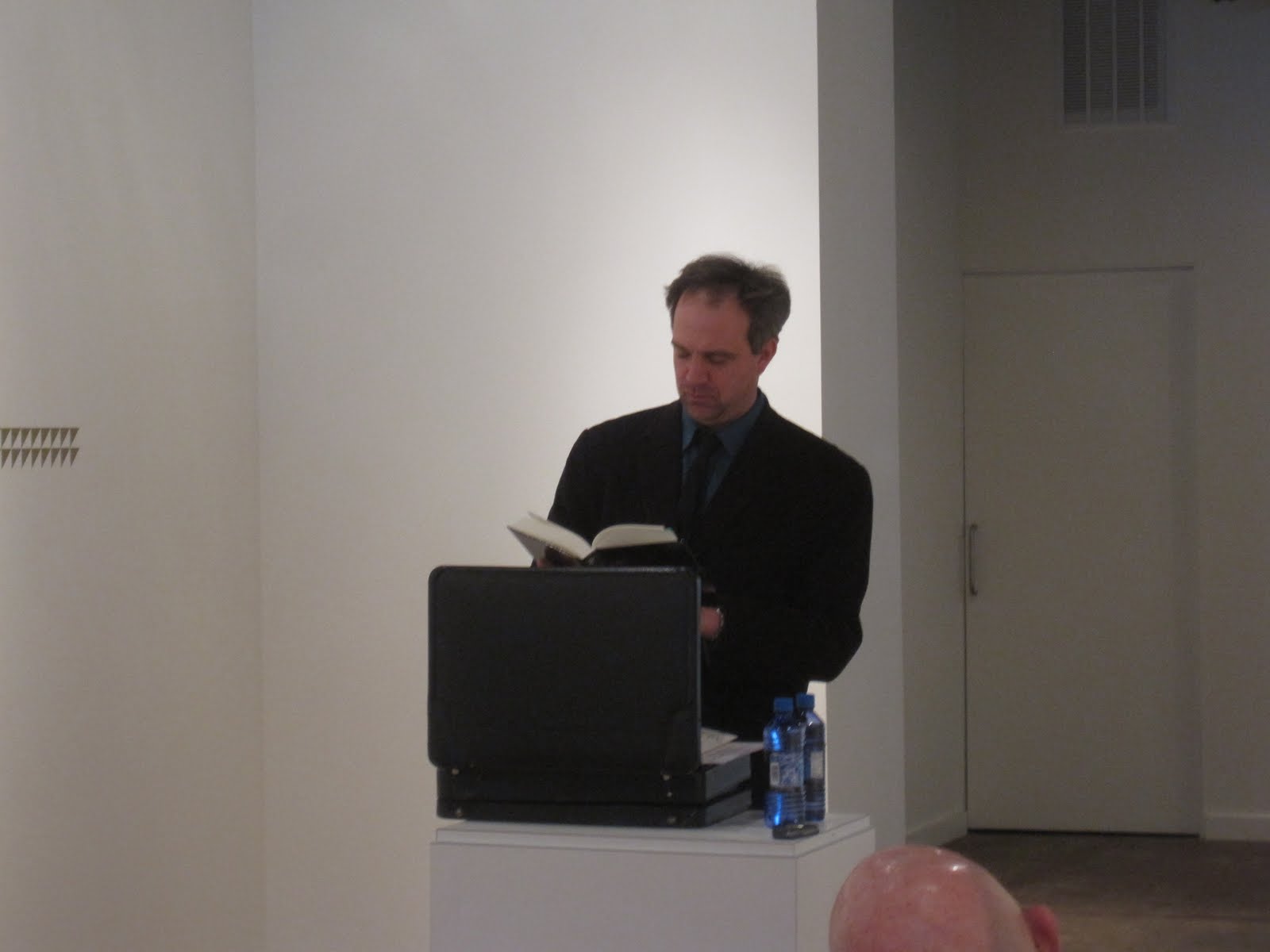
Scenes from ESLF

Here are some pictures from Early Spring Literary Festival (more can be found here). It was a great time! Thanks to everyone who was able to make it out to the events. Thanks to all the 9L contributors, William Gillespie, Adam Levin, T.A. Noonan, and Peter Orner, for terrific readings.


Wednesday, March 16, 2011

ESLF: Ninth Letter Reading

Don't forget today is the Ninth Letter reading with featured writers T.A. Noonan and Adam Levin. The event is at 2pm in the Author's Corner on the 2nd floor of the Illini Union Bookstore. Below you can check out my interview with T.A. and be sure to tune into WILL-AM's Focus 580 at 11am (central time) for an interview with Adam. You can stream the broadcast live, so you don't need to be in Urbana-Champaign to hear it.

Check out the Early Spring Literary Festival schedule for a complete list of the final day events. All of the events, including the Ninth Letter reading, are free and open to the public. Hope to see you there!

Tuesday, March 15, 2011

ESLF - Day 3

Here's a reminder that the Early Spring Literary Festival continues today with two event featuring 9L contributor Peter Orner (vol. 7, no. 2). The details:

Panel Discussion: Bearing Witness with Philip Graham, Cary Nelson, Peter Orner, and Sue Silverman at 10:00am.

Peter Orner and Sue Silverman reading at 4:30pm.

Both events will be in the Author's Corner on the 2nd floor of the Illini Union Bookstore.

Check out the ESLF schedule for a complete list of today's events. The events are free and open to the public. Hope to see you there!

Monday, March 14, 2011

ESLF: Adam Levin

It's time for the next installment in our series of posts about 9L contributors participating in the Early Spring Literary Festival and this time we turn our attention to Adam Levin.

If you haven't heard, Adam Levin has made quite the stir, and rightfully so, in the literary world with his first novel, The Instructions. While the book is over a 1,000 pages that doesn't mean Adam Levin can't write one hell of a short story. His story "A Qualitative Study of Our Father," a collaboration with Christian TeBordo, appeared in the very first issue of Ninth Letter (vol. 1, no. 1). It tells the story of siblings Jimmy and June studying how and, more importantly, why their father kills flies. And it's written in the form of a scientific study complete with hypothesis, methods, and discussion sections. The potential risk of this type of piece is having the form overwhelm the content or for it all to seem a bit gimmicky. If it was nothing but a gimmick, the reading experience would be unsatisfying. A clever idea will only get you so far. However, this is not a problem for "A Qualitative Study of Our Father." What the story does so brilliantly is to marry form and content, so that how the story is told reveals something about the characters, particularly Jimmy and June. They are the kind of smart, practical kids that would examine their father's behavior in such a methodical way. We also learn that this detached approach might be a coping mechanism. Through the design of the form, including the occasional footnote with the title of their previous studies, we are given a complete picture of this family. Danger is in these children's lives. In fact, the conclusions section contains a warning to their baby sister, if she were to ever embark on her own study of their father, "Take caution against the whole business, Jessica. You are not a fly. You are the prettiest little girl." Ultimately, the story offers no easy solutions. A lot of elements are being juggled in the piece, but, as it always does in a great story, it seems effortless. "A Qualitative Study of Our Father" is a rich, compelling read.

Adam Levin is a part of the Ninth Letter reading, along with T.A. Noonan, on Wednesday, March 16 at 2pm in the Author's Corner on the 2nd floor of the Illini Union Bookstore.

Here is an interview with Adam about The Instructions and an essay he wrote about the novel.

And The Instructions book trailer:

ESLF/Kick-Off Reading

The Early Spring Literary Festival is in full swing now. Here are some pictures from yesterday's kick-off reading at the Figure One gallery with Amy Hassinger and William Gillespie.


ESLF continues today. Be sure to check the schedule for a full list of events. Today's highlights include Kevin Stein reading at 4:30pm in the Author's Corner on the 2nd floor of the Illini Union Bookstore.

Tonight at 7:30 is "Prayers for the People: Carl Sandburg's Poetry and Songs," which will be held in Smith Hall on the U of I campus. A full description can be found on the library's Rare Book and Manuscript site.

Saturday, March 12, 2011

ESLF Kick-off

Tomorrow is the official kick-off of the Early Spring Literary Festival! The first event is a reading with Urbana-Champaign writers Amy Hassinger and William Gillespie (vol. 1, no. 2 & vol. 7, no. 2) at the new Figure One gallery in Champaign. Here are the details:

Date: Sunday, March 13
Time: 4pm
Location: Figure One, 116 N. Walnut St., Champaign

Following this reading will be the next installment of Stories and Beer. Illinois almunus and O'Henry Prize winner Ted Sanders and Illinois MFA candidate Lara Adamczyk will be reading with visiting writers and ESLF panelists Dave Housley, Chad Simpson, and Jim Ruland. The details:

Date: Sunday, March 13
Time: 6pm
Location: Indi Go Gallery, 9 E. University Ave., Champaign

Both events are free and open to the public. It will be a great time. Hope to see you there!

Wednesday, March 09, 2011

ESLF: T.A. Noonan

Next up in our series looking at 9L contributors participating in the Early Spring Literary Festival is T.A. Noonan. Her essay, "The Trouble with Correspondence" is featured in the spring/summer 10 issue (vol. 7, no. 1). Currently, I'm in the midst of interviewing T.A. for the next edition of 5 (or so) questions, which I'll post during the festival next week.

Right now, here's a little bit about the essay. A simple description for this essay would be that "The Trouble with Correspondence" is about T.A. delving into the practice of witchcraft, while also wrestling with her body image. Of course, the essay if far more complex than that, asking big, tough questions. How can you reconcile being a witch and your catholic upbringing? How can you accept your body the way it is when society says you shouldn't? However, what makes the essay so compelling is how personal it is. We see her struggling with these questions. We understand how witchcraft and body image, alone and together, impact her life. What she has to say about body image is not often heard in the media: being fat does not mean you are weak. The essay is bold, thought provoking, and honest. Without further delay here is an excerpt of "The Trouble with Correspondence."

Ask a man off the street to describe a witch, and he might conjure a barefoot, gypsy-skirted girl. Another might imagine black-robed figures sacrificing kittens and drinking babies' blood from a cauldron. Still another might think of his landlady.

The problem of witchcraft boils down to a problem of language. Take, for example, some of the current synonyms for witch -- Wiccan, pagan, neopagan, heathen. Despite what The Oxford English Dictionary and various thesauruses say, the terms aren't equivalent. Even witches don't know what to call themselves half the time.

But here's what I know: Wiccans follow a system of tenets and beliefs reconstructed by Gerald Gardner, an amateur anthropologist, in the 1950s. A pagan is anyone who doesn't practice Islam, Judaism, or Christianity. Neopaganism is a subset of paganism that includes various recontructionist, Goddess-centeric, and/or polytheistic belief systems. Heathen -- originally used to refer to an ignorant, non-Christian peasant -- is now the reclaimed title of a Nordic-themed neopagan sect. It's like this: squares are rectangles, but a rectangle isn't always a square. Wiccans are witches, but a witch isn't always Wiccan. Witches are pagan, but a pagan might not be a witch. Or sometimes a witch is a pagan -- witchcraft isn't tied to religion. A person can be Christian and practice witchcraft.
To read "The Trouble with Correspondence" pick up a copy of vol. 7, no. 1 in our webstore!

T.A. Noonan will be reading along with Adam Levin as part of the Ninth Letter reading on Wednesday, March 16 at 2pm in the Author's Corner on the 2nd floor of the Illini Union Bookstore.

Monday, March 07, 2011

ESLF: Peter Orner

For the next post in our series on 9L contributors participating in the Early Spring Literary Festival, we turn our attention to Peter Orner. His essay, "Horace and Josephine" is in the current issue (vol. 7, no.2).

Orner's nonfiction work shares a lot of the same great qualities he brings to his fiction. They are rich, fulfilling experiences on the initial read, but what makes them truly spectacular is that more and more depth is revealed on subsequent reads. Making this feat even more impressive is the economy of his prose. Orner can express an entire lifetime in only several pages. This is certainly the case with "Horace and Josephine." At first glance, the essay could be read as simply a tale of eccentric relatives dealing with the change in their social and economic status after Horace gets caught embezzling money. However, it also very much a love story. Horace's and Josephine's love story. One that sneaks up on you because the beginning is very much about Horace's scams and how that ripples throughout the entire family. The end of the story firmly focuses on the ultimately heartbreaking relationship between Horace and Josephine. The emotion of the last scene is overwhelming. Confession: I've read the essay dozens of times by now and I still can't read the end without tearing up. A wonderful thing about the essay is that when you go back to the beginning, you see how it was a love story the whole time, even though it doesn't first appear that way. The end works, it is earned emotion, because Orner, as he does in his fiction, has done such a suburb job of building the characters, in this case his relatives, on the page. We see what makes them flawed, tragic, and importantly we see their capacity for love.

"Horace and Josephine" is available in the current issue (vol. 7. no, 2), so head on over to our webstore to pick up a copy.

To read a great example of Peter Orner's fiction check out "On a Bridge Over the Homochito" which appears in his short story collection, Esther Stories.

Here are the details for Peter Orner's appearances at the Early Spring Literary Festival:

Panel Discussion: Bearing Witness with Philip Graham, Cary Nelson, Peter Orner, and Sue Silverman on Tuesday, March 15 at 10:00am.

Peter Orner and Sue Silverman reading on Tuesday, March 15 at 4:30pm.

Both events will be in the Author's Corner on the 2nd floor of the Illini Union Bookstore. The events are free and open to the public. Hope to see you there!

Friday, March 04, 2011

ESLF: 5 (or so) Questions with William Gillespie

Today is the first in a series of posts taking a closer look at the Ninth Letter contributors who will be participating in the Early Spring Literary Festival here at the University of Illinois in Urbana-Champaign. For this installment, 9L staffer Laura Adamczyk interviewed William Gillespie by email about his poem, "Newspoem" in the current issue (vol. 7, no. 2). Enjoy!

9L: In "Newspoem" you write: "The only restriction the academy puts on my writing is that after two years I have to check a box to indicate whether it's poetry, prose, tech, drama, or theory. This, of course, is not that. This is a letter." Would you indeed call this a letter? Why do you think people are so obsessed with putting the "right" genre labels on work?

William Gillespie: A work of writing, properly labeled, is a bomb defused and buried in a sealed canister. WARNING: CONCEPTUAL POEM: DO NOT ATTEMPT TO READ.

9L: This piece directly considers its reader. The "friend" that the speaker is writing to feels like a specific person at times and a general reader at others, the speaker expressing his compulsion for seemingly anyone to read his work. My question is: Who do you imagine as the ideal reader for this piece?

WG: In 1996 I attempted to write a poem a day about the news. These newspoems were posted on wall and given to friends. In 1999, I set up a newspoetry website, which continued for four years. I continue writing newspoetry for walls and the web.

In this newspoem -- dated Novemeber 1996 -- I attempted to write a personal letter a day to various friends, and then combined them into a month-long personal letter to an amalgamation. So the poem is literally epistolary.

9L: "Newspoem" has an elusive, slippery quality to it. Just when I thought I had a handle on it, it shifted. Mixed metaphors and wordplay abound. I wonder if you could respond to a question your speaker asks his reader: "Why memorize a song if it destroys the pleasure of reading it on the page?"

WG: Music and dance notation fascinate me. Except for player piano rolls, decoding encoded music must lead to different results each time. Interpretation is necessary. Same with recipes. I find this act of translation beautiful. I don't know why. Text can describe, but also encrypt, sound, movement, flavor.

9L: The motif of music runs throughout the piece (e.g. repetition of "The obvious analogy is with music). For me, it had a manic energy of a really long punk song (a bit of an oxymoron, yes) or something by James Chance. What kind of song would this be if it were a song? What band or artist would perform it?

WG: I wish I could say a long composition by King Crimson circa 1973 like "Lark's Tongues in Aspic," with different movements and strident rock violin. But it's probably more a cut-up like John Zorn's "Tre Nel 5000." Or "Revolution 9," only better. There's a punk defiance in its rigorous discontinuity. I considered it unpublishable until you guys published it.

9L: Lastly, an old professor of mine once said that all writers really just want to be rock stars. Are we just a bunch of rock wannabes without the stage presence?

WG: Yes. And without the money.

Thanks to William Gillespie and Laura Adamczyk for a wonderful conversation. To read "Newspoem" and all the other fantastic poems, stories, and essays, pick up a copy of the current issue (vol. 7, no. 2) in our webstore.

Be sure to make it out to the kick-off reading for the Early Spring Literary Festival on Sunday, March 13 at 4pm at Figure One in downtown Champaign to hear William Gillespie and Amy Hassinger read from their work.